All Creatures Great & Small
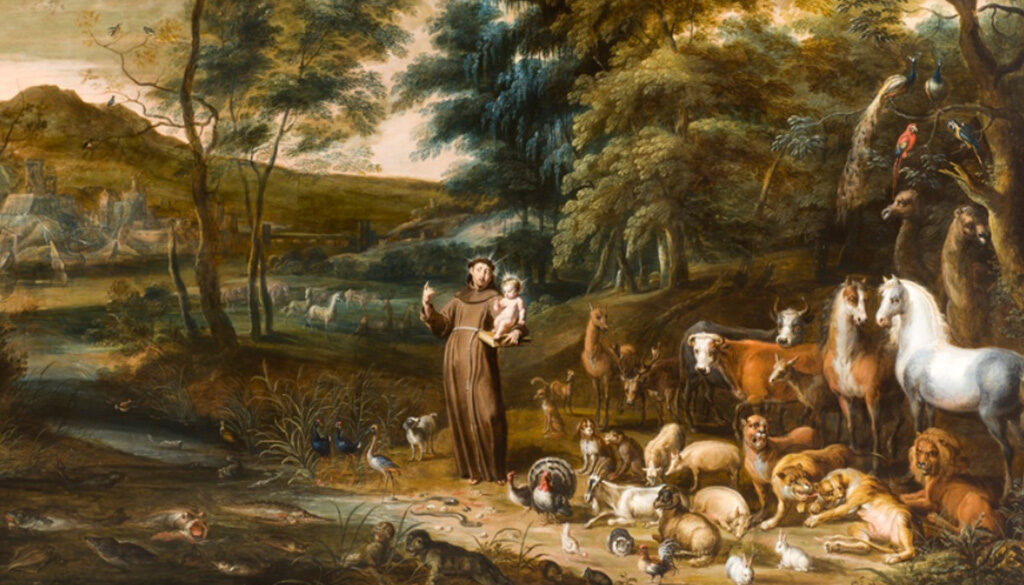
If anyone, Catholic or otherwise, knows one aspect of Saint Francis of Assisi’s life, that aspect is probably his association with nature. Countless artworks show him with birds on his hands or shoulders, recalling the story of his preaching to the birds, and often with other animals gathered at his feet, sometimes including a wolf in memory of the wolf of Gubbio. He is known for addressing these creatures, and even inanimate elements, as “Brother” and “Sister.”
How does Francis’s love for nature fit into his overall message and mission? To dismiss this love as mere sentimentality would be to make the same mistake as his contemporaries, seeing only his unusual outward actions and not the mystical flame of love animating them from within.
Natural Love
A difficulty for Catholics today is that, in our present culture, “the environment” is so often thought of as something separate from, or even opposed to, the social and spiritual needs of human beings. This way of thinking, however, would never even have occurred to Saint Francis. For him, all creatures had sprung from the hand of God just as he himself had, and were therefore his brothers and sisters, entitled to his respect and love.
G.K. Chesterton, in his biography of Saint Francis, expands on this line of thought. “St. Francis was not a lover of nature,” Chesterton says, in the sense of a vague or naïvely romantic “sort of sentimental pantheism.” Rather, his all-embracing love of God translated naturally into love for everything God had made: “He wanted to see each tree as a separate and almost a sacred thing, being a child of God and therefore a brother or sister of man.” Francis’s attitude could be understood as an echo of the look of love that God gave His world when it was newly made: “And God saw everything that he had made, and behold, it was very good” (Gen 1:31).
Canticles of Creation
The most iconic example from Francis’s life may be his “Canticle of the Sun” or “Canticle of the Creatures.” He composed this exalted hymn in his last year on earth, ravaged by sickness and pain, his failing eyes no longer able to see the beauty around him. Amid these sufferings, the saint gathered everything he had contemplated in the preceding years into a song of praise from the depths of his heart. Like the three young men in the fiery furnace (Daniel 3:29-68), he invited all his brothers and sisters in the natural world to join him in praising God.
Seen in this light, Francis’s example offers a valuable lesson to our time. Like him, we are called to receive the world from God’s hand, not as simply a set of resources, obstacles, or substances with no significance, but as a wondrous gift to be cherished. Pope Francis, in his 2015 encyclical Laudato Si’—which takes its name from the first words of the Canticle of the Creatures, meaning “Praise be to you”—describes this spirit in which his namesake approached the world: “Saint Francis, faithful to Scripture, invites us to see nature as a magnificent book in which God speaks to us and grants us a glimpse of his infinite beauty and goodness” (LS §12).
A Spirit of Wonder
Furthermore, this love and reverence for nature, far from being opposed to human interests, is closely bound up with them: “He [Saint Francis] shows us just how inseparable the bond is between concern for nature, justice for the poor, commitment to society, and interior peace” (LS §10). Francis’s love, imitating the love of Christ, encompassed all his human brothers and sisters and all the extended family of non-human creatures, recognizing that God made them for harmony and interdependence. That Saint Francis, the saint of mercy who had such great devotion to the poor, should also have had such love for nature illustrates that care for God’s creation is an important way of serving our fellow human beings, especially those in most need.
Receiving the natural world with respect and love can not only enrich our earthly lives but bring us closer to God. For instance, at the Shrine of Our Lady of Guadalupe in La Crosse, the landscape of the Wisconsin bluff country has been carefully incorporated and preserved, and gardens cultivated throughout the grounds. The pilgrim’s contemplation is thus surrounded and supported by the beauty of God’s handiwork, lifting up the heart and mind to Him.
We might not be used to thinking of care for nature as an element of sanctity, but for Saint Francis, anything that God loved deserved his own love. Seeing all creatures this way, as so many members of one great family, he could regard them with delighted wonder and sincere affection, even in his deepest sufferings. Through his intercession, may we cultivate a spirit of wonder at Our Lord’s world, and out of that wonder, approach it with reverent love.