Rediscover the Radical Way of St. Therese
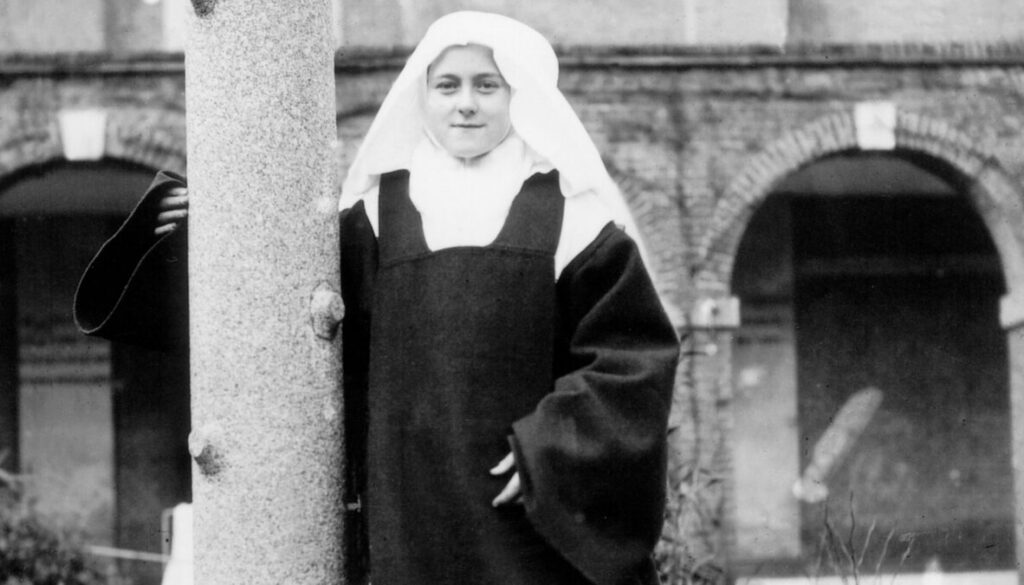
Saint Thérèse of Lisieux (1873–1897) is one of the Shrine’s patrons, venerated in the first side altar on the right from the Shrine Church’s entrance. She is among the best-known and loved saints of the Church. Yet this very familiarity may overshadow Thérèse’s unique character and powerful teaching.
The common impression of Thérèse is sometimes sentimentalized: a sweet young nun surrounded with roses, speaking of herself and her little deeds as little flowers on a “Little Way” to heaven. In reality, that Little Way was a trail blazed with courage, wisdom, and intense, tenacious love. In the words of Pope Pius XII, she “rediscovered the heart of the Gospel” in a time when false teachings had obscured it.
Outwardly, Thérèse’s life was smooth and straightforward: She was the youngest in a deeply pious middle-class family in nineteenth-century France, the daughter of Saints Louis and Zelie Martin and, after Zelie’s death, mothered by four older sisters who all became nuns. At fifteen she entered the Carmelite convent in her hometown, and lived there in joyful, peaceful obscurity until her death of tuberculosis at twenty-four.
Sheltered though she was, Thérèse experienced the darkness of her world. Among French Catholics, Jansenism had been a strong influence since the seventeenth century. This rigorist heresy, taught by the Dutch bishop Cornelius Jansen, emphasized human sinfulness and depicted God as severe and exacting. Those who fell victim to its influence were unlikely to think of closeness to God, especially in Holy Communion, as even a goal to consider, never mind a reality that God desired for them.
Thérèse, despite her loving family, did not escape the effects of Jansenism. In her autobiography she describes a phase of scrupulosity in her childhood, in which “all my most simple thoughts and actions became the cause of trouble for me.” (Story of a Soul, ch. IV) Even after this trial ended, she was not free from anxieties. As she later admitted, “I had such a great fear of soiling my baptismal robe [through mortal sin]” until a holy priest assured her, a few months after she entered the convent, that she had not committed any mortal sins and God was very pleased with her. (ch. VII)
From there the Holy Spirit led Thérèse to ever deeper discoveries of divine love and trust in God, until she could write, “It is confidence and nothing but confidence that must lead us to love.” In increasingly bold freedom, she let her burning desires rise to God. “I have always wanted to be a saint,” she wrote to her superior. Seeing how much greater the saints were than she did not discourage her; instead, “I said to myself: God cannot inspire unrealizable desires. I can, then, in spite of my littleness, aspire to holiness.” (ch. X)
For a time, Thérèse’s desires did appear impossible. She loved God with a passion that made her want to live every vocation and suffer every martyrdom. She wanted “to preach the Gospel on all the five continents … until the consummation of the ages.” (ch. IX) Trying to make sense of her longings, she prayed and meditated with Scripture, and eventually came to 1 Corinthians 13, the great chapter on holy love. This was her great revelation; as she wrote: “I understood that love comprised all vocations, that love was everything … my vocation, at last I have found it … my vocation is love! … Thus I shall be everything, and thus my dream will be realized.” (ch. IX)
With this penetrating insight, Thérèse rediscovered not only her vocation but that of everyone. The truth that Jansenism—and many false teachings before and since—had buried under fear is that God calls each human being to live in His love. This is the power of Thérèse’s “Little Way” and why it can be for anyone. Everyone has days full of small, mundane things to be done. If we do them in a spirit of trusting love, we truly are living every vocation: We endure countless tiny “martyrdoms”; we offer God our sacrifices and so participate in the priesthood; we are missionaries, by word, example, and prayer, even if we never travel. Thérèse did all that from the hiddenness of her cloister.
During her last, painful illness, Thérèse no longer found it easy to believe all she had learned and taught. All emotional consolation of faith left her; she mysteriously shared in the experience of unbelievers who could not recognize the reality of God or heaven. This inner darkness was for her “a wall which reaches right up to the heavens and covers the starry firmament.” (ch. X) Thérèse suffered this state for the last eighteen months of her life.
Yet even in that darkness, the Holy Spirit moved her to say, “I feel that my mission is about to begin, my mission of making others love God as I love Him, my mission of teaching my little way to souls.” Her prophecy was fulfilled with extraordinary speed. After her death, her community published her autobiography; within two years, a second edition was needed. Thérèse and her Little Way spread like heavenly fire.
Today that fire blazes throughout the world, attracting all kinds of people, including non-Catholics. Thérèse has indeed become a missionary to the whole world until the end of time. Her life of simple heroism and unshakeable confidence in God has made her one of the greatest witnesses to His infinite love. Each of us, following her teaching and example, can say as she did, “I can, then, in spite of my littleness, aspire to holiness.”