How to Venerate a Relic at the Shrine
The Shrine of Our Lady of Guadalupe is consecrated to ceaseless prayer and devotion. One way this is lived out is in fostering and providing opportunity for devotion to the saints.
Patron Saints of the Shrine
At the Shrine, the faithful encounter first and foremost the Queen of All Saints, Our Blessed Mother, who leads us to her Son. And after her, pilgrims also are invited to grow in devotion to several patrons of the Shrine whose example also leads to Christ. These include Saint Kateri Tekakwitha and Blessed Miguel Pro, both of whom have first-class relics interred in the altar of the Shrine Church. Other relics are permanently displayed in the side altars, including Saint Maria Goretti, Saint Therese of Lisieux, and Saint Gianna Beretta Molla.
Relics at the Shrine
One of the great blessings of making a pilgrimage to the Shrine is the opportunity to venerate the relics of these and many other saints and to ask for their intercession.
The Shrine is blessed with a sacred collection of authenticated relics of the saints. These treasures are made available for public veneration on their feast days. When planning your pilgrimage, make sure to check to see what relics may be available for veneration during your visit to the Shrine. It is an experience not to be missed.
How to Venerate a Relic?
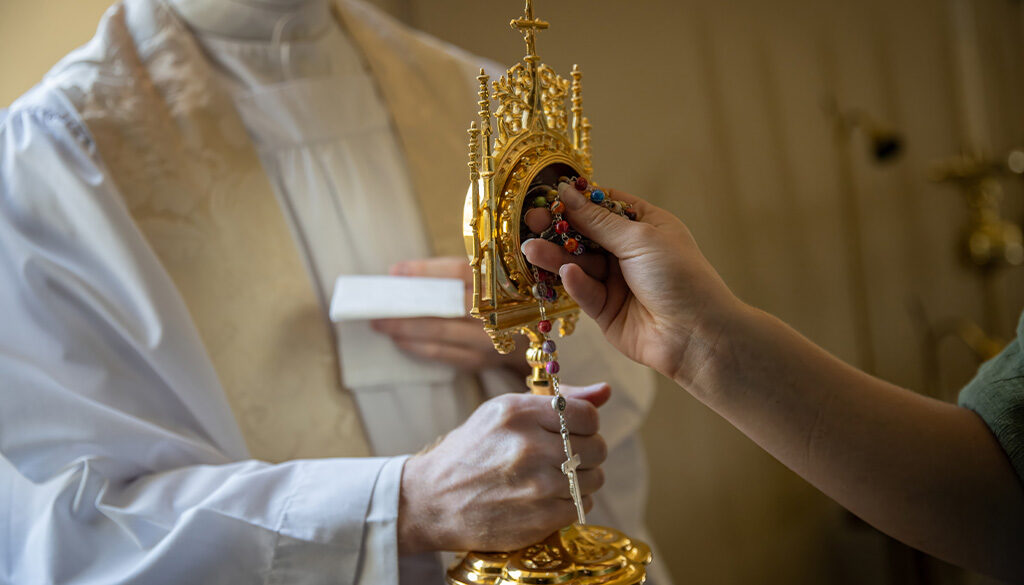
Veneration of a relic simply means showing devotion and appreciation for the saint who lived a praiseworthy life and who we believe is now in Heaven with God. There are certain steps when venerating a relic in a shrine or church. Deacon Chris Kabat explains how to venerate a relic in this video.
What is a Relic?
A relic is a physical reminder of the saint who lived a holy and praiseworthy life on earth and who is now in heaven. In the Church today, relics are listed in three categories. A first-class relic is a piece of a saint’s body, usually a sliver of bone or a lock of hair. A second-class relic is some possession of the saint, such as a piece of clothing. Third-class relics are anything touched to a first-class or second-class relic.
History of Relic Veneration
Relics of saints have value because God made human beings as creatures of body and spirit (CCC §362–365); therefore, the body is sacred even after someone has died. Furthermore, God works in His creatures’ lives in a way fitting to the nature He gave them, giving grace through physical means. The Incarnation is the ultimate example, but others occur throughout salvation history.
Among these, Scripture includes instances of grace given through the bodies of holy people. Possibly the first example, and one of the most dramatic, appears in 2 Kings 13:21, when a dead man thrown onto the bones of the prophet Elisha immediately returns to life. In the New Testament, even the shadow of Saint Peter and the clothing of Saint Paul are enough to heal the sick (Acts 5:15, 19:12).
The veneration of saints’ relics was one of the earliest devotions of the Church, as can be seen in ancient writings, including those of the Church Fathers. Among these is an explicit description from Saint Jerome: “We do not worship, we do not adore … but we venerate the relics of the martyrs in order the better to adore Him whose martyrs they are.”
The Council of Trent (Sess. XXV) summarized the Church’s teaching on relics, explaining that the saints’ bodies “were the living members of Christ and ‘the temple of the Holy Ghost’ (1 Corinthians 6:9) and … are by Him to be raised to eternal life and to be glorified” and therefore “are to be venerated by the faithful, for through these [bodies] many benefits are bestowed by God on men.” Because God Himself has made the saints’ bodies sacred, He shows His power through them.
Plan Your Pilgrimage
To take advantage of the many opportunities to grow in prayer and devotion at the Shrine, especially through veneration of the saints, explore the full schedule of relic veneration at the Shrine. Then, plan your pilgrimage today!