Saint Anthony Beyond the Legend
Who Is Saint Anthony?
This Holy Year of Saint Francis is a fitting time to show special honor to saints of the Franciscan Order. Among these, Saint Anthony of Padua (1195-1231), whose feast day falls on June 13, deserves special mention. Widely known as the saint invoked when car keys or cell phones go missing, Saint Anthony is one of the beloved holy figures whose life story is sometimes obscured by his legend or popular image.
Besides lost items, Wikipedia lists a great number of subjects under Anthony’s patronage, including “lost people.” The care of those who struggle to know where to go, either literally or in the sense of making choices, is appropriately entrusted to this saint whose own journey through life took so many twists and turns.
Call to the Priesthood
Despite his nickname “of Padua,” Anthony was not a native of Italy, but of Portugal. Named Fernando at baptism, as the only son of a noble family, he was expected to inherit his father’s title and estates. At fifteen years old, Fernando defied that custom to enter religious life—with the Augustinian order. He performed brilliantly in his studies for priesthood, learning a great deal of theology that would be useful to him in ways he never expected.
Fernando was still quite young when the relics of the first Franciscan martyrs were brought to Portugal from Morocco. Their heroism lit such a fire in his heart that he requested, and eventually obtained, permission to transfer to the newly founded Franciscan order, taking the name Anthony. He was also permitted to follow in the footsteps of his heroes and journey to Morocco, hoping to die a martyr’s death. But God had other plans; no sooner had Anthony arrived than he became seriously ill. A few months later, he was told to return.
Anthony never came back to Portugal. Stormy weather drove the ship instead to Italy. Thus far nothing had gone as he planned when he asked to become a Franciscan; but his obedience to God’s Providence would soon bear fruit.
His Gift of Preaching
In Italy, Anthony was welcomed by the nearest Franciscan community. He lived quietly until 1222, when he attended an ordination of Dominican and Franciscan priests. It became apparent at the last minute that no one was prepared to preach at this event. Anthony was asked to step in, and delivered such an eloquent, moving sermon that all hearts were touched.
From then on, Anthony was sent out to preach, continuing his spiritual father Francis’s work of rebuilding the Church, ministering to those who had been neglected so long. This was the work for which he had prepared in his years of prayerful study, toward which the Spirit had been leading him through his attempts to die a martyr. All too few of the thirteenth-century working class had heard God’s word spoken to them by a man of God who lived it. This lack meant, unsurprisingly, that ignorance and heresy were everywhere.
Anthony was precisely the man who was needed: When he spoke, people listened, struck by both the power of his words and the holiness of his life. His preaching is described as focusing on “the grandeur of Christianity.” StAnthony.org expands on that thought: “Anthony preferred to present the grandeur of Christianity in positive ways. It was no good to prove people wrong: Anthony wanted to win them to the right, the healthiness of real sorrow and conversion, the wonder of reconciliation with a loving Father.”
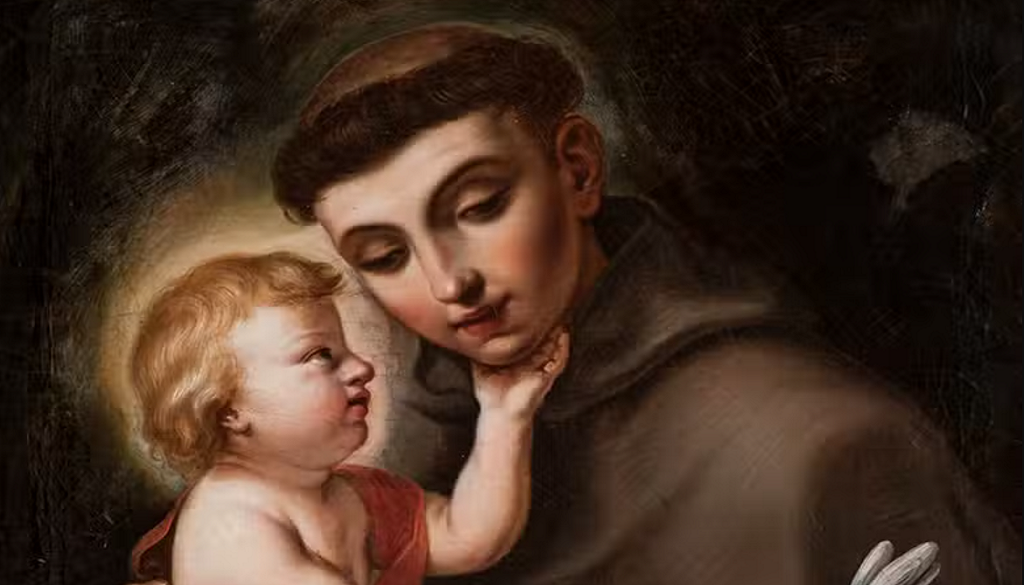
The legends of miracles in Anthony’s life abound: preaching to a school of fish after a town turned him away, which moved the people to change; proving the reality of the Eucharist to a heretic by successfully calling on the man’s mule to adore the Host; and, of course, the visit of the Child Jesus. Yet the greatest wonder of his life is the many souls that were led back to God through him. Besides his own preaching, he was also assigned to teach his fellow friars, so that they too might offer an effective witness wherever they went.
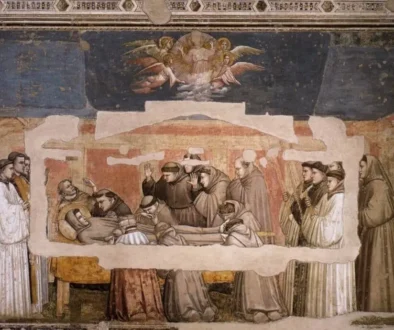
When Anthony died, just outside his beloved headquarters of Padua, he was not quite thirty-six years old. Yet he had served untold numbers of people with his message of God’s truth. Above all, he had lived wholeheartedly the Franciscan spirit of joyful poverty, missionary zeal, and all-consuming, self-giving love.
Saint Anthony of Padua, pray for us!